Local conditions
What Coolum Beach's Sand and Storms Mean for Stump Removal
Coolum Beach grew up around its beach and around Mount Coolum, the steep volcanic plug just south of town that still dominates the skyline and gives walkers one of the coast's better climbs. The town hosted the 2002 Commonwealth Heads of Government Meeting and has long drawn a mix of permanent residents, retirees and holiday-letting investors to its older cottage blocks close to the water, with newer housing filling in toward Peregian Springs. That mix of generations of housing is exactly why stump grinding in Coolum Beach covers such different jobs, from a decades-old beach shack's overgrown garden to a modern townhouse clearing scrubby regrowth before landscaping.
The ground itself is coastal sand: free-draining and easy to dig, but it lets roots spread wide rather than driving deep, so a stump that looks small on top can still have a root plate running well past where you'd expect it. Cocos palms, pandanus and frangipani dominate the older gardens, and palm stumps in particular are fibrous and water-holding rather than hard, which changes how they grind and what the debris looks like.
Storms are the other local factor. Coolum sits exposed to the open coast, and severe weather warnings bring down limbs and uproot shallow-rooted palms more often than they do a few kilometres inland. For owners and letting agents, the practical impact is that storm clean-up and routine garden stump removal often happen in the same visit, and a stump left half-cleared after a storm is just as likely to become a trip hazard on a holiday-let lawn as an eyesore.
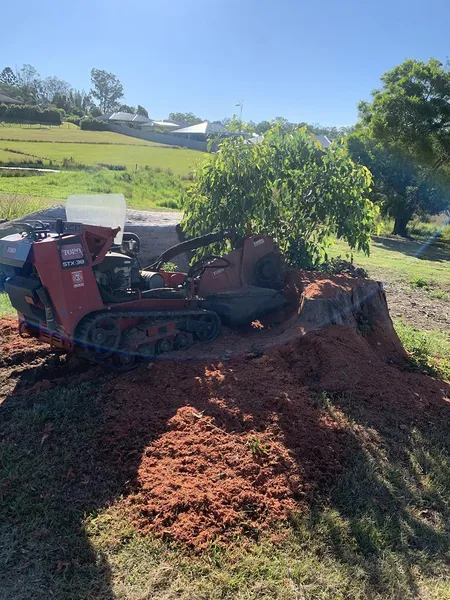
We grind to a depth that suits what's going over the stump (turf for a family garden, paving for a renovation, or just a clean, level block for the next tenant) and we flag any root spread that reaches toward a neighbouring boundary before we start, not after.