Local conditions
Slopes, Clay and Sugar-Era Gardens: Stump Removal in Nambour
Nambour developed as the service and milling centre of the Sunshine Coast hinterland, and it still looks the part: a compact commercial centre in a valley on Petrie Creek, with residential streets climbing steeply out of it in every direction. Until 2003, cane trains ran through the middle of town to the Moreton Central Sugar Mill, and the surrounding slopes carried cane, bananas, pineapples and small crops. That agricultural past matters for stump grinding in Nambour, because as farm land was subdivided for housing through the mid-twentieth century, the new yards were planted with the shade and fruit trees of the era, mango, poinciana, jacaranda, avocado, and a great deal of camphor laurel.
The terrain and soil then set the constraints. Hinterland clays are heavy and moisture-retaining, so roots are shallower and broader than in the free-draining red soils further east, and wet ground stays wet. Combine that with slopes and you get the two problems Nambour owners bring us most: stumps sitting in ground too steep or soft to drive a machine onto, and stumps that were previously cut low and have thrown up a thicket of regrowth ever since.
Why it matters practically: on a sloping block, a rotting stump and dying root plate can loosen soil above a retaining wall or path, and regrowth from a camphor laurel stump can put a new trunk against your fence within a few seasons. For landlords, an untreated stump is a trip hazard and a recurring maintenance cost.
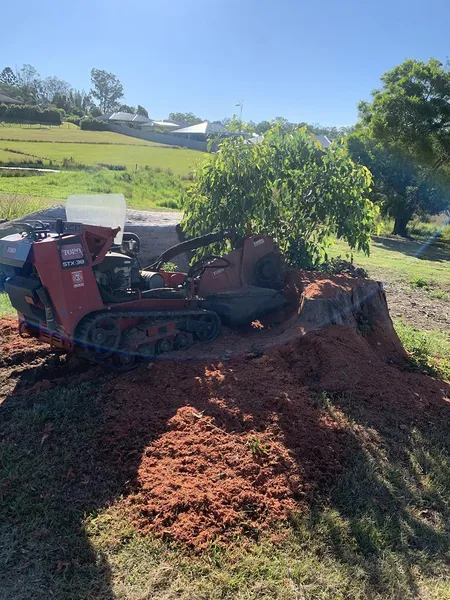
Our approach is to inspect the access line and ground condition first, schedule around wet weather rather than churning up a slope, and grind to full depth with the laterals removed so regrowth stops for good. Where the ground is unstable, we backfill and compact, and recommend mulch or planting to hold the surface through the wet season.